
A culture that turns pride into a public virtue should not be shocked when humility, truth, and repentance disappear from public life.
This editorial ran in the Tuesday 16 June 2026 edition of the Moscow-Pullman Daily News.
We live in an age that celebrates what Pope Gregory the Great ranked first among the Seven Deadly Sins: pride, the desire to put self where God belongs.
“Believe in yourself.” “Follow your truth.” “Live your authentic self.” The message surrounds us, especially this time of year. Pride is no longer treated as a vice to resist but as a virtue to embrace. Movements, campaigns, and institutions urge us to put self at the center of everything.
Yet for nearly two thousand years, Christians taught the opposite.
The church fathers, Augustine, Aquinas, Calvin, and countless others viewed pride as the root of human rebellion against God. It was not one sin among many. It was the fountainhead from which the others flowed.
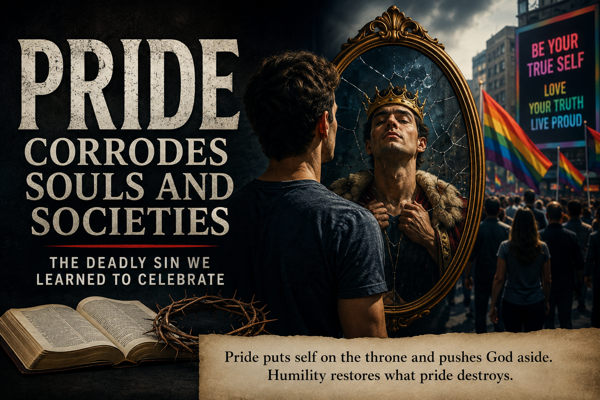 Pride is not confidence. It is not competence. It is not satisfaction in good work. A father grateful for his children, a craftsman pleased with excellence, or a citizen thankful for his country is not guilty of pride because he appreciates God’s blessings.
The sin enters when gratitude gives way to self-exaltation.
But pride is more subtle than that.
Many people think pride means thinking too highly of yourself. Sometimes it does. But pride can also appear in those who constantly think too poorly of themselves. One man boasts about his greatness. Another obsesses over his failures, wounds, and insecurities. Both are consumed with themselves.
The problem is not always high self-esteem. The problem is self-preoccupation.
Pride is being consumed with yourself. The boastful man stares into the mirror and admires what he sees. The insecure man stares into the mirror and despairs. Both are trapped in the same prison. Their attention never leaves themselves.
The Bible presents pride as humanity’s oldest temptation. The serpent did not tempt Eve with fruit. He tempted her with autonomy: “You will be like God” (Genesis 3:5). The appeal was not hunger but self-rule. Adam and Eve wanted the authority to define good and evil for themselves.
That same temptation remains with us today.
Many sins involve weakness. Pride involves rebellion.
A greedy man may admit he wants too much. A drunkard may admit he has a problem. A glutton may acknowledge a lack of self-control. Pride is different. Pride refuses correction. Pride insists it already knows best. Pride places self at the center and demands that reality adjust accordingly.
Once self becomes supreme, every other vice becomes easier to justify.
In politics, leaders refuse to admit mistakes. Every failure becomes someone else’s fault. Every criticism becomes an attack.
In culture, objective truth gives way to “my truth.” Feelings outrank reality. Personal preference replaces moral standards, and affirmation becomes the highest commandment.
In daily life, pride appears whenever we refuse to apologize, forgive, or admit we were wrong.
Even our therapeutic culture feeds the problem. We are told to examine ourselves, affirm ourselves, discover ourselves, and express ourselves. Every struggle becomes a journey inward.
Yet many people seem more anxious, fragile, and unhappy than ever. That should not surprise us. A life spent staring into a mirror rarely produces wisdom. The soul was not designed for self-absorption. It was designed to worship God and serve others.
The opposite of pride is not low self-esteem. The opposite of pride is humility.
Humility does not mean weakness, insecurity, or self-hatred. It means seeing ourselves accurately. It means recognizing our strengths and limits. It means understanding that we are creatures, not gods.
Humility frees us from constantly measuring ourselves against everyone else. It lets us learn because we admit we do not know everything. It lets us repent because we admit we have sinned. It lets us love our neighbors because we stop making ourselves the center of every story.
Every healthy family, church, business, and nation depends on that virtue.
Pride, by contrast, corrodes every institution it touches. It destroys marriages, fractures friendships, fuels political conflict, and blinds people to their own faults. It convinces individuals and societies they can flourish while ignoring the God who made them.
The ancient warning remains as relevant as ever: “Pride goes before destruction, and a haughty spirit before a fall” (Proverbs 16:18).
We may live in a culture that hangs banners, sells slogans, and celebrates pride as moral courage, but reality has not changed. The deadliest form of pride is not swagger or arrogance. It is the quiet conviction that self should sit at the center of the universe. A society built on that foundation cannot stand forever.
The question is not whether pride still leads to a fall. The question is whether we will recognize it before the fall arrives.