
Idaho spends less than every state, yet its math scores expose the myth that bigger school budgets buy better results.
This editorial ran in the Tuesday 19 May 2026 edition of the Moscow-Pullman Daily News.
Every few months, the same headline sails back into view: Idaho spends less per student than any other state. The implication never changes: Idaho must hate education, neglect children, and repent by spending more money.
But what if the data refuse to cooperate?
The latest reports put Idaho at the bottom in per-pupil K-12 spending. Idaho Ed News reported that the state spent $11,167 per student in fiscal year 2024, compared with a national average of $17,499. That sounds dramatic, and the usual chorus knows its lines: lament the ranking, blame conservatives, and demand more money.
But spending is an input, not an outcome. It tells us what government spent, not what students learned.
That distinction matters because leftists treat education spending like a moral sacrament. More money means virtue. Less money means cruelty. Academic failure never discredits the system; it only feeds demands for bigger budgets and more control.
 That is backward.
We should care whether children can read, write, do math, and become disciplined, knowledgeable, capable young adults. We should not confuse a larger budget with a better education.
If money directly bought achievement, the highest-spending states would dominate national tests, and Idaho would sit near the bottom. NAEP shows otherwise.
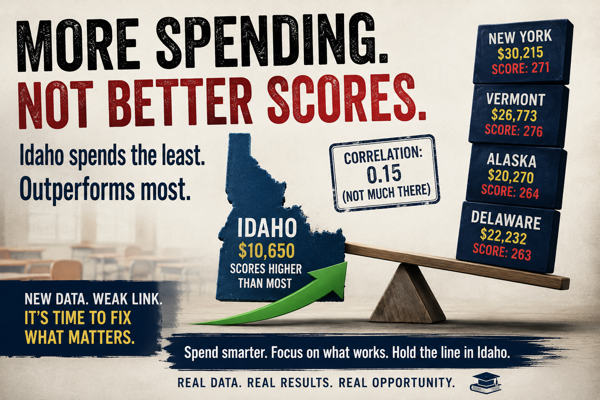
In 2024, Idaho scored 278 on eighth-grade NAEP math, placing it roughly in the top quarter of states. That alone should halt the panic. Idaho spends the least, yet outperforms most states that spend more.
New York spends nearly three times as much per student as Idaho and scores lower in eighth-grade math. Vermont spends more than twice as much and also scores lower. Alaska and Delaware spend more and perform worse. If raw spending drove achievement, those states should lap Idaho. They do not.
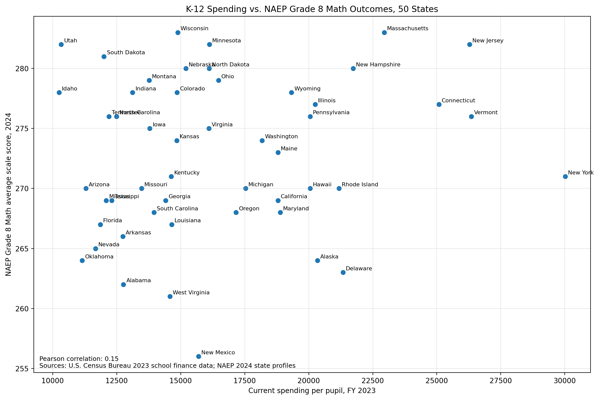 The 50-state spending-versus-performance chart tells the story. If more spending produced better scores, the data would form a clean upward line: more money, better results. Instead, the chart looks like a shotgun blast. The dots scatter all over the page. Some states spend a lot and score well. Some spend a lot and score poorly. Some spend little and score poorly. Idaho spends little and scores well.
The statistical relationship is nearly nonexistent. Forgive me while I revert to my math background. Pearson correlation simply measures how closely two numbers move together. If spending and scores rose together in a tight upward line, the correlation would be close to 1.0. If they had no clear relationship, it would sit near 0. In this 50-state comparison, the correlation is only 0.15. In plain English, spending and scores barely move together at all. The chart sits next to “nothing there.”
 The r2 number makes the point even clearer. It answers a simple question: how much of the difference in state math scores can be traced to spending? The answer is 2.2%. Put plainly, spending explains only about two pennies of every dollar of difference among states. The other 97.8% comes from something else: problems the spending lobby deliberately obscures while demanding even more money.
That does not mean money never matters. Nobody serious says schools can run on fumes. But specific needs require specific arguments, not a lazy demand to pour more money into the same system and expect better results.
Too much of the education debate treats schools like a hole in the ground. Pour in more money. Then pour in more. When results disappoint, blame taxpayers for not pouring fast enough. Taxpayers need to ask whether the hole is the problem.
The left avoids this question because it shifts attention from funding to accountability. The spending lobby keeps the debate emotional, not mathematical. Once voters compare soaring budgets to stagnant outcomes, the narrative weakens. Which schools deliver results at cost? Which districts spend on administration while classrooms lag? Which charter, private, homeschool models outperform the monopoly? Which programs work, and which just employ people?
Those are better questions than “How much more can we spend?”
Idaho must stop apologizing for winning a spending contest. The goal is not to spend like New York; it is to educate Idaho children. Idaho should not rush to copy states that spend far more and score far worse.
Education reform must start with outcomes, not rituals. Measure learning. Reward what works. Cut what fails. Push dollars toward classrooms, not bureaucracy. Give parents more choices, not fewer. And stop pretending that every education problem can be solved by writing a larger check.
Results matter. Results, not rhetoric. Results, not rankings. Results, not another round of budget panic from people who worship spending and ignore the children it is supposed to serve.