After another anti-Trump assassination attempt, America must confront the rhetoric, media myths, and online mobs turning political murder into moral theater.
This editorial ran in the Tuesday 5 May 2026 edition of the Moscow-Pullman Daily News.
What country treats assassination as political speech?
The WHCA dinner attack exposed the pattern. Reports say the suspect wrote a manifesto naming administration officials as targets, prioritized by rank. Secret Service agents were conditional targets. Hotel employees and guests were supposedly off-limits unless they blocked him. That is political violence with rules of engagement.
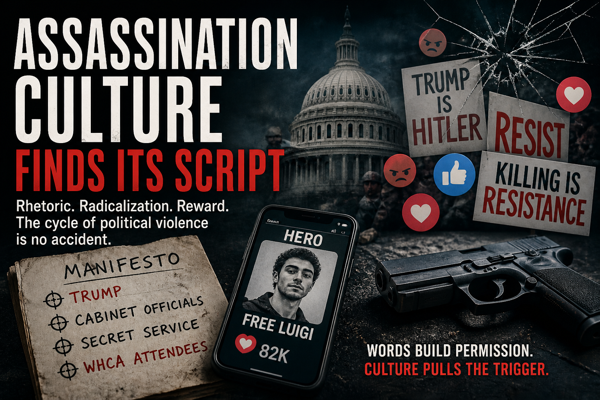 The irony is clear. The leftist press spent years pushing the “Trump is a Nazi” narrative, and the assassination attempt came at the WHCA dinner, the press corps’ annual gathering.
For years, Democrats, corporate media, activists, and influencers have called Trump a pedophile, fascist, Nazi, traitor, dictator, and existential threat. Once you tell weak people that one man is Hitler and democracy dies unless he is stopped, what will they conclude?
Words do not pull triggers. People do. But they build moral permission structures. A threat belongs in one category. Campaign bluster belongs in another. But conspiratorial demonization is different. The shooter’s manifesto reportedly echoed the same script: Trump as pedophile, rapist, traitor, and enemy of the people. Convince unstable people the target is evil, then act surprised when someone tries to stop evil.
After every attack, the same pundits condemn violence, send prayers, and call for unity. Then they return to the vocabulary that poisoned the room. The left lit the match, poured gasoline on the fire, then condemned flames.
Jimmy Kimmel’s “expectant widow” joke about Melania Trump was grotesque, but the deeper issue is the years of framing behind it. Kimmel has repeatedly accused Trump of protecting pedophiles, being tied to Epstein, and being a rapist. One bad punchline is ugly. The worldview underneath is worse.
One bad joke does not cause assassination. But one grain of sand does not make a dune. Keep adding “Trump is Hitler,” “Trump is a rapist,” “Melania would be happier as a widow,” and “Luigi is a hero,” and eventually some fool concludes murder is overdue. The snowflake never blames itself for the avalanche.
The Luigi Mangione case showed where this culture can lead. After UnitedHealthcare CEO Brian Thompson’s murder, parts of the online left made the accused killer a folk hero. Memes, merchandise, and fundraisers followed. Even CNN’s Van Jones warned the WHCA suspect could get the same treatment.
The narrative shield is cracking. Data from the Center for Strategic and International Studies show anti-government attacks and plots hit their highest level since 1994, and far-left attacks outnumbered far-right attacks. Molotov cocktails appeared in seven attacks or plots. The old claim that political violence is mostly a right-wing problem no longer explains the evidence; it hides it.
Social media accelerates it. Murder becomes a meme before the blood dries. The weak-minded do not need a formal command. They need a story, a target, and a tribe ready to applaud.
That should sound familiar. We spent two decades studying how jihadists radicalize weak minds online: isolate the recruit, feed grievance, identify an enemy, sanctify violence, and surround him with digital applause. The left-wing pipeline uses different theology but similar psychology: propaganda, moral permission, and a community ready to call murder “resistance.”
That is why the “ordinary radical” matters. Allen was not some forgotten loner beyond institutions. He reportedly held a Caltech engineering degree, interned at NASA, taught part time in California, donated to ActBlue, and compared Trump’s 2024 win to “Nazis getting elected.” Nicholas Roske, the California substitute teacher who tried to assassinate Justice Brett Kavanaugh, was also college educated and politically radicalized. The problem is what respectable institutions can train people to believe.
Some now reach for the laziest escape hatch: it was staged. That denies agency and spares the movement from asking whether “Trump is Hitler” rhetoric helped radicalize another unstable man. It also explains why some accused Erika Kirk’s tearful evacuation from the WHCA dinner of being staged, even after her husband, Charlie Kirk, had been assassinated months earlier. Conservatives warned this would happen. Celebrate Mangione, joke about dead presidents, smear Trump as a pedophile-rapist-traitor, and someone eventually takes the script seriously.
The real answer is moral clarity. Condemn assassination without footnotes. Stop calling political opponents Nazis. Stop lionizing murderers because their victim fits your politics. Political murder is evil, even when the target is someone you hate. Violence does not stay aimed where its authors intend. It spreads, mutates, and burns through public trust.
If the republic is to survive, we must say no now. No to assassination politics. No to murder memes. No to revolutionary cosplay. No to the cowardly lie that violence becomes moral when the right people bleed. No, clearly and repeatedly: no.