Don’t expect privacy, even when you’re dead.
If you’ve ever imagined a scenario where police demand you unlock your phone and thought, “Over my dead body!” — we have bad news for you. Here in our absurd dystopian future, having a phone means that upon your demise you could find yourself participating — limp and lifeless — in a legal search and seizure of your own digital property.
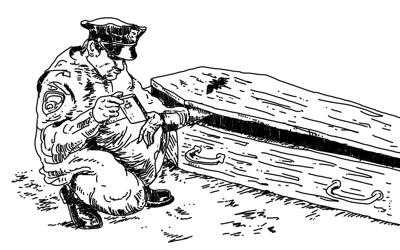
Police in Largo, Florida, recently tried to use a dead man’s finger to open his phone. This was to the complete astonishment of his family and probably also the staff at the Sylvan Abbey Funeral Home. Detectives just rolled right in with Linus F. Phillip’s phone and asked staff where his corpse was. They then attempted to unlock his phone by pressing his hands and fingers on to the fingerprint sensor.
The dead man’s fiancée, Victoria Armstrong, told press, “I just felt so disrespected and violated.”
Mr. Phillip, an unarmed black man, was shot and killed outside a gas station after police claimed he tried to drive away during a search. His death was ruled a “justifiable homicide.” His family does not trust the investigation into his death.
“They were trying to open up that cellphone using a dead man’s finger,” the family’s attorney, John Trevena, said. “That’s disgusting beyond words.”
Attempts by police to use the dead man’s hands for what they claimed was “to preserve evidence” by unlocking his phone were unsuccessful. The alleged evidence on his phone, the press wrote, was “to aid in the investigation into Phillip’s death and a separate inquiry into drugs,” according to Lt. Randall Chaney.
“We can’t remember having unlocked a phone in that fashion, either at the scene, the medical examiner’s office or the funeral home,” Lt. Chaney said.
How police are using corpses to unlock phones
That was the first publicly known instance of posthumous Touch ID access attempts by authorities, though there have been more since. “Separate sources close to local and federal police investigations in New York and Ohio,” Forbes wrote in March, “who asked to remain anonymous as they weren’t authorized to speak on record, said it was now relatively common for fingerprints of the deceased to be depressed on the scanner of Apple iPhones.”