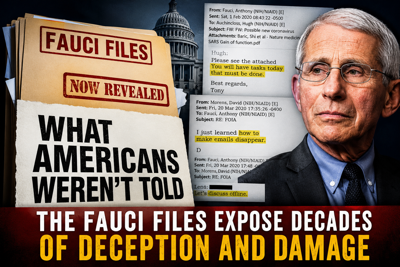
Fauci’s own files reveal that while Americans endured sweeping COVID restrictions, key officials privately questioned assumptions the public was told not to challenge.
This editorial ran in the Tuesday 11 August 2026 edition of the Moscow-Pullman Daily News.
When Dr. Anthony Fauci appeared before the Senate last week, the biggest story wasn’t merely that he invoked the Fifth Amendment 111 times. The Senate Homeland Security and Governmental Affairs Committee voted to hold him in contempt of Congress after he refused to answer questions under oath despite already possessing President Biden’s blanket pardon covering potential federal offenses committed between Jan. 1, 2014, and Jan. 19, 2025.
That reversal comes as newly released Fauci files, declassified documents, and congressional investigations show an increasingly troubling picture of how Americans were misled during the COVID-19 pandemic.
I have written about COVID since the earliest days of the pandemic. In April 2020, I argued that instead of locking down healthy Americans, we should isolate the infected, quarantine the vulnerable and exposed, and let the rest of society continue with sensible precautions. I warned that the cure could become worse than the disease.
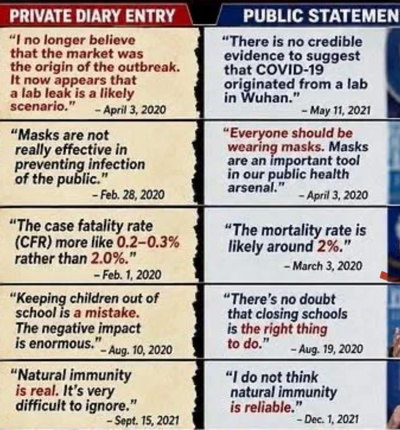
 Later that year, I argued that schools should remain open because COVID overwhelmingly targeted the elderly and those with serious underlying health conditions, not children. I questioned whether cloth masks could stop an airborne virus and warned against treating every American as though they faced equal risk. At the time, those positions were dismissed as irresponsible, anti-science, or conspiracy theories. The label “conspiracy theory” became a substitute for engaging the evidence.
Meanwhile, Americans were expected to accept policies that defied common sense:
- Masks required while walking to a restaurant table, but unnecessary once seated.
- Playgrounds, beaches, and parks closed in the name of public health.
- Liquor stores and marijuana dispensaries deemed “essential” while churches, schools, and countless family businesses were ordered to close.
- COVID-positive patients sent into nursing homes while families were barred from visiting dying loved ones.
Today, the question is no longer whether Fauci made mistakes. The question is whether Americans were denied an honest scientific debate while those policies were being imposed.
One of the most disturbing revelations comes from Fauci’s longtime adviser, Dr. David Morens. According to the Justice Department indictment, Morens discussed making emails “disappear” after Freedom of Information Act requests, deleting records after forwarding them to a private Gmail account, and privately delivering sensitive information to Fauci rather than using official government channels. It is difficult to reconcile those actions with Fauci’s famous declaration that, “I represent science.”
 Fauci’s first documented response after learning that prominent virologists believed SARS-CoV-2 might have been engineered was not to alert the public or openly investigate the possibility. Instead, he immediately focused on NIH-funded gain-of-function research involving the Wuhan Institute of Virology, sent his deputy the 2015 Baric-Shi paper, instructed him that “tasks today… must be done,” and convened an urgent teleconference with leading virologists.
Why does any of this matter? Dr. Steven Quay, a physician-scientist under final consideration for Fauci’s former NIAID post, argues that SARS-CoV-2’s genetic makeup was unlike a typical bat-virus spillover. It “magically” appeared already optimized for infecting human cells. If officials had seriously considered that possibility from the outset, the public health response would have been very different.
Instead, governments responded as though they were confronting another natural animal-to-human outbreak. Yet the virus was already optimized for rapid human-to-human transmission, demanding a fundamentally different response. Those false assumptions became the foundation upon which governments built their entire pandemic response.
That foundation also shaped countless personal tragedies. Families were barred from comforting dying loved ones. Weddings and funerals were canceled. Healthy children were kept out of classrooms. Churches were shuttered. Businesses built over decades disappeared in months. These were not merely policy disagreements. They were life-altering consequences flowing from assumptions that Americans were not allowed to question.
The greatest casualty of the pandemic may not have been a political career or a scientific reputation. It was public trust. Fauci himself anticipated that danger decades earlier. In an October 2001 diary entry, he wrote, “I believe that there will be hell to pay when the American public realizes that they have not been dealt with in a totally open manner.” Six years later, Fauci’s own warning has become the indictment.
Americans deserved an honest scientific debate in 2020, not manufactured certainty. Instead, policies that reshaped everyday life were built on assumptions that key officials privately questioned but publicly defended. Families buried loved ones alone. Children lost years of education. Businesses disappeared. Public trust in medicine and government was shattered. COVID also gave Americans a glimpse of what centralized planning looks like in practice: one set of rules, one approved narrative, and no room for dissent. The Fauci files remind us that scientific uncertainty must never again be replaced with political certainty.