This is what happens when you send unprepared kids to college: enrollment but not graduation. Oh, and racking up enormous college debt but without the degree and income at the end to repay it.
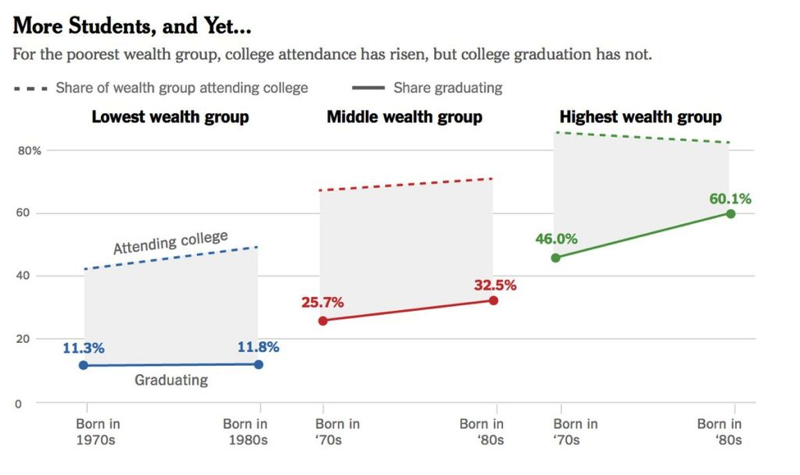
More first-generation, low-income students are going to college — but not completing a degree, writes David Leonhardt in theNew York Times. “The college-graduation rate for these poorer students is abysmal,” he writes.
His chart, based on anew studyinDemography, shows the growing graduation gap.
Employers aren’t impressed by job applicants with “some college,” but no degree, writes Leonhardt.
Since 2000, the average inflation-adjusted wage of workers with some college credit but no degree has actually fallen, by 2 percent, according to a recent report by the Economic Policy Institute. The average wage of college graduates is up 6 percent.
College dropouts often “have to repay college debt without the extra earning power of a degree,” he writes. It’s “the worst of both worlds.”
Already, some colleges have started to make impressive changes. Georgia State has raised its six-year graduation rate sharply. A network of 11 universities, including Kansas, Michigan State and the University of California, Riverside, are working together — imagine that — to share student-success strategies. In New York, community colleges in the CUNY network have created a program that nearly doubled graduation rates.
Lavishing high-need students with support has improved graduation rates at the University of Texas and Wayne State in Detroit, writes David Kirp, a professor of public policy at Berkeley.
Via Joanne Jacobs