Twenty-five years after 9/11, America still lives with emergency powers born in fear, and it is time to ask which ones still belong.
This editorial ran in the Tuesday 8 September 2026 edition of the Moscow-Pullman Daily News.
Some events burn themselves into memory. Decades later, I can still remember where I was, what I was doing, and small details that should have disappeared long ago.
I had just turned four when President John F. Kennedy was assassinated on Friday, November 22, 1963. I remember my mother crying in front of the television. And, as you might expect from a four-year-old, I remember that my Saturday morning cartoons were preempted the next day.
On April 4, 1983, while attending the Navy’s Nuclear Power School in Orlando, we were released from class to go outside and watch Challenger launch on its maiden flight.
Three years later, I was at the Charleston Naval Shipyard. On January 28, 1986, I was on watch when some enlisted sailors came running in saying the Space Shuttle Challenger had exploded.
 No one believed them. A space shuttle couldn’t just explode.
But it had. Throughout the day, the video of the explosion was replayed over and over on the television in the berthing barge.
Then came Tuesday, September 11, 2001.
I was in Monterey, California, at the Naval Postgraduate School. The radio reported that American Airlines Flight 11 had struck the World Trade Center’s North Tower. My boss, a retired Navy commander and Vietnam veteran, and I talked about how unlikely it was that a pilot could accidentally fly an airliner into one of those towers.
Seventeen minutes later, the news came that United Airlines Flight 175 had struck the South Tower.
Any thought of an accident vanished. We looked at each other. “That was no accident.”
About 35 minutes later, American Airlines Flight 77 slammed into the Pentagon, killing 184 people.Twenty-five minutes later, the passengers aboard United Airlines Flight 93 fought back, and the plane crashed in Pennsylvania.
America was under attack.
I remember Kennedy. I remember Challenger. But 9/11 was different. We didn’t simply remember September 11. We changed America because of it.
Al-Qaeda Islamist terrorists murdered 2,977 people that morning. The government had both the authority and the duty to defend Americans against another attack.
And America responded.
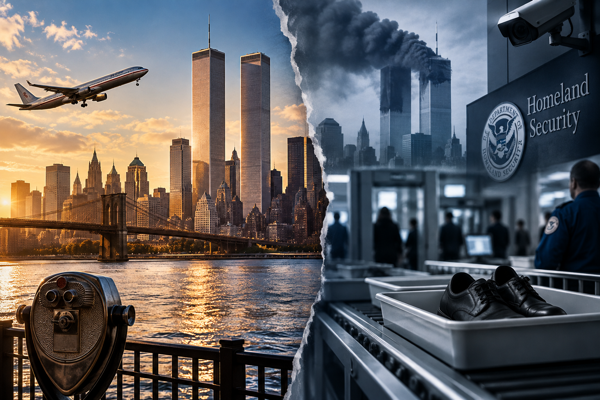
The changes reached far beyond airport checkpoints. Washington built new systems for sharing intelligence and watching potential threats. The Patriot Act expanded the federal government’s power to spy on Americans. Practices that would have seemed extraordinary on September 10 soon became ordinary.
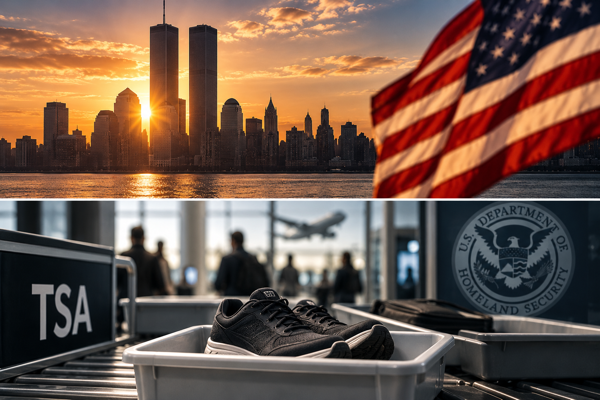
Congress created the Transportation Security Administration. Airport security became a federal responsibility. The federal government consolidated 22 agencies and created the Department of Homeland Security. America went to war in Afghanistan and later Iraq.
 Some measures were justified by the danger we faced. Liberty does not require government to pretend enemies do not exist. But neither does danger erase constitutional limits. A free people should be especially careful about powers granted out of fear. Government action is immediate and visible. We often don’t recognize the loss of our liberty until much later.
Emergencies expand government. When the emergency passes, government rarely gives back what it gained.
A frightened public asks government to do something. Politicians oblige. New agencies appear. New powers are granted. New spending becomes permanent. Each step may sound reasonable when considered by itself, particularly when the alternative offered is another terrorist attack.
Twenty-five years later, we have the luxury, and the responsibility, to ask questions that were difficult while the ruins were still smoking.
Which changes actually made us safer? Does taking off our shoes at the airport accomplish anything, or merely remind us the TSA is in charge? Which restrictions should have expired years ago? And how many liberties have we surrendered so gradually that we no longer notice they’re gone?
That last question matters.
People born on September 11, 2001, turn 25 this week. They have no memory of meeting family members at an airline gate or walking through airport security without today’s federal apparatus. They have never known an America without the War on Terror or the Department of Homeland Security.
What one generation accepts as an extraordinary response to an emergency, the next generation inherits as normal life.
As the 25th anniversary of 9/11 approaches, Americans will again remember where they were when the planes struck. We should remember the 2,977 people murdered by Islamist terrorists, the police officers and firefighters who ran toward danger, and the passengers of Flight 93 who fought back.
But after 25 years, perhaps we should remember something else, too: the America that existed on September 10.
A generation has grown up knowing only the America we built in response to 9/11. It is time to ask how much of it we still need.